MassHealth: The Basics – Enrollment Update
This chart pack provides updated MassHealth enrollment data as of November 2015.
Related Items
Collection

This chart pack provides updated MassHealth enrollment data as of November 2015.
This chart pack, prepared by Manatt Health Solutions, provides an examination of the current state of long-term services and supports (LTSS), an area identified as a priority for reform by MassHealth (Massachusetts Medicaid). MassHealth accounts for nearly half of all spending on LTSS, amounting to $4.5 billion annually, and equal to 12 percent of the state budget. Using previously unpublished LTSS data, the chart pack examines MassHealth LTSS spending and utilization, access and affordability, workforce capacity and quality. It also includes a summary of opportunities to improve delivery and coordination of LTSS.
Findings from this chart pack were featured at a Foundation event held on December 2, 2015, MassHealth Matters II: Long-Term Services & Supports (LTSS): Opportunities for MassHealth.
This budget brief highlights the fiscal year (FY) 2016 budget for MassHealth (Medicaid) and other subsidized health coverage programs. It is the last in a series of FY2016 budget briefs produced by the Massachusetts Medicaid Policy Institute (MMPI) in partnership with Rob Buchanan and Tom Dehner of Health Management Associates.
UPDATED (July 2015) chart pack, prepared by the Center for Health Law and Economics at the UMass Medical School, includes summary data on MassHealth enrollment and spending and is designed to support use of the charts in presentations. Updated edition includes MassHealth enrollment as of March 2015 and spending from state fiscal year 2014.
Social determinants of health, which encompass social, behavioral and environmental influences on one’s health, have taken center stage in recent health policy discussions. While research indicates that greater attention to these non-medical factors may improve health outcomes and reduce health care costs, translating this evidence into actionable recommendations for policy makers and others has been challenging. This report, prepared by a team led by Elizabeth Bradley of the Yale Global Health Leadership Institute and Lauren Taylor of the Harvard Divinity School, evaluates and synthesizes the evidence base for interventions that address social determinants of health, with special attention to innovative models that may improve health outcomes and reduce health care costs and that may be applicable in the Massachusetts policy context. Based on this review, there is strong evidence that increased investment in select social services (e.g., housing support and nutritional assistance), as well as various models of partnership between health care and social services (e.g., integrated health care and housing services), can result in substantial health improvements and reduced health care costs for targeted populations.
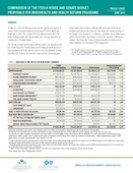
This brief describes the Massachusetts Senate fiscal year (FY) 2016 budget proposal for MassHealth (Medicaid) and other subsidized health coverage programs and compares it to the proposal put forth by the House. It is the third in a series of FY2016 budget briefs produced by the Massachusetts Medicaid Policy Institute (MMPI) in partnership with Rob Buchanan and Tom Dehner of Health Management Associates. MMPI will be publishing budget briefs at several stages in the FY2016 budget process as proposals move through the state legislature.
In this issue brief, Patricia Boozang, Deborah Bachrach and Hailey Davis of Manatt Health Solutions, review the coverage and delivery system challenges that Massachusetts could address through sections 1331 (the Basic Health Program) and 1332 (Waivers for State Innovation) of the Affordable Care Act (ACA). This brief describes the federal requirements related to these sections of the law and identifies the options the Commonwealth could pursue to advance its coverage, fiscal, and policy priorities, including: improving affordability and ease of access to coverage for low-income residents, continuing the expansion of insurance coverage to hard-to-reach populations, and evaluating and revisiting policy decisions like the individual mandate to determine the best fit for Massachusetts.
Peter Hussey, Courtney Armstrong, and Eric Schneider of the RAND Corporation conducted interviews with seven health plans and five Accountable Care Organizations (ACOs) to determine their support for innovative delivery system models including payment arrangements, program development strategies, and the criteria decide whether or not to support these programs. All interviewees are currently engaged in innovative care delivery efforts aimed at improving quality and reducing the cost of healthcare and believe that the current payment system has not moved far enough away from fee-for-service to support meaningful delivery system changes. The report suggests that a shift towards alternative payment methodologies, an alignment of incentives across payers, and a better understanding of the impact of care delivery transformation are all necessary to achieve sustainability. The authors find that the main challenge in innovation will building capacity and managing financial risk, particularly for smaller and less-experienced provider organizations.
Click here to read the report.

This brief describes the Massachusetts House of Representatives fiscal year (FY) 2016 budget proposal for MassHealth (Medicaid) and other subsidized health coverage programs. It is the second in a series of FY2016 budget briefs produced by the Massachusetts Medicaid Policy Institute (MMPI) in partnership with Rob Buchanan and Tom Dehner of Health Management Associates. MMPI will be publishing budget briefs at several stages in the FY2016 budget process as proposals move through the state legislature.
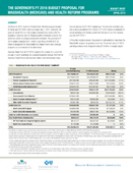
This brief describes the governor's fiscal year (FY) 2016 budget proposal for MassHealth (Medicaid) and other subsidized health coverage programs. It is the first in a series of FY 2016 budget briefs produced by the Massachusetts Medicaid Policy Institute (MMPI) in partnership with Rob Buchanan and Tom Dehner of Health Management Associates. MMPI will be publishing budget briefs at several stages in the FY2016 budget process as proposals move through the state legislature.
Unless Congress acts, federal funding for the Children’s Health Insurance Program (CHIP) will run out soon after September 2015. On March 26, the U.S. House of Representatives passed legislation that would fund CHIP for two more years. The Senate is expected to take up the bill in mid-April. This report, written by Robert Seifert of the Center for Health Law and Economics at the University of Massachusetts Medical School, examines the serious implications for Massachusetts if federal funding for CHIP is not extended.
Megan Burns and Michael Bailit of Bailit Health Purchasing, LLC, provide a comprehensive review of payment reform in Massachusetts and, in particular, how the changing landscape is affecting safety-net providers. For this report, safety-net providers—those providers characterized by serving a high percentage of Medicaid beneficiaries and uninsured individuals—includes both community health centers and hospitals. Building off state-collected data that details the adoption of alternative payment models (APMs) by payers over the course of 2012 and 2013, the report adds qualitative findings gathered from a sample of payers and providers in mid-2014. The qualitative findings focus on the variation in characteristics of Massachusetts global payment arrangements and the impact the contracts are having on safety-net providers. The report concludes with several recommendations that payers, the state, or foundations could provide to aid safety-net providers in their preparation for payment reform.
This report, written by Robert Seifert, Michael Grenier, and Jean Sullivan of the Center for Health Law and Economics at the University of Massachusetts Medical School, summarizes the history of the MassHealth 1115 waiver and examines the key components of the new waiver extension, organized around five themes: coverage, services, delivery redesign, support for the safety net, and looking to the future. This most recent waiver extension, which the Centers for Medicare and Medicaid Services (CMS) granted in October 2014, is for five years (until June 30, 2019). However, a major component—the Safety Net Care Pool—was extended for only three years (until June 30, 2017), with the terms for the remaining two years subject to further negotiation.
In conjunction with the full report, the authors developed an abbreviated summary of the MassHealth 1115 waiver, which provides an overview of the new provisions approved under the waiver renewal.
Responsible for the health care coverage of nearly two million residents and $13.7 billion in related expenditures, the future of MassHealth matters to all of us. This report, by Manatt Health Solutions, includes a series of recommendations that emerged through interviews with consumer advocates, providers, insurers, business leaders, public officials, and policy experts as priorities for the next governor.
Findings from this report were featured at a Foundation event held on December 9, 2014, MassHealth Matters: Priorities for the New Administration. Click here to learn more about the event and to see a copy of the slide presentation of the report by Patricia Boozang, Managing Director of Manatt Health Solutions.
Click here to watch the MassHealth Matters video.
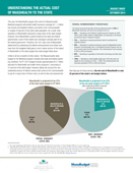
This brief describes the "net" state cost of MassHealth (determined by subtracting the federal reimbursement and similar revenues from the budgeted total), providing a much clearer picture of the impact of MassHealth on the state budget than state budget totals alone. It is a supplement to a series of FY2015 budget briefs produced by MMPI in partnership with the Massachusetts Budget and Policy Center.