2012 Massachusetts Health Reform Survey
Affordability Gap Remains Despite Coverage Gains

This collection of reports and chart packs is the latest in a series by the Urban Institute analyzing the results of the Massachusetts Health Reform Survey (MHRS), which has been conducted since 2006. This round of the survey, which was fielded in the fall of 2012, was jointly funded by the Robert Wood Johnson Foundation and the Blue Cross Blue Shield of Massachusetts Foundation. These results provide both a means for continuing to monitor the efforts in Massachusetts to sustain the coverage gains achieved through the 2006 health reform law and an important new baseline against which to assess the impact of the state’s efforts to improve the affordability of care and reduce health care spending. Findings show that while coverage and access to care remain strong in Massachusetts, health care costs continue to be a burden for many individuals and families.  

This year’s results are presented in a variety of publications including:

For those interested in learning more about the methodology of the survey, please see this report and this survey instrument tool.

The Blue Cross Blue Shield of Massachusetts Foundation and the Robert Wood Johnson Foundation will be making the complete survey results for all six years of the survey available for public use through the Inter-university Consortium for Political and Social Research.

Findings from the survey were featured at a Foundation event on March 26, 2014. See materials from the event located here.

A Glossary of Cost Containment Terms

This glossary, prepared by the Blue Cross Blue Shield of Massachusetts Foundation with input from the Center for Health Information and Analysis and the Health Policy Commission, defines some of the key cost containment terms necessary to understand Chapter 224 of the Acts of 2012 and the health care cost dialogue in Massachusetts.

The Innovators: What the Innovation Fund for the Uninsured 2001–2010 Teaches Us about Delivering Better Health Care

From 2001 through 2010, the Foundation awarded $10.5 million to 48 organizations across the Commonwealth through the Innovation Fund for the Uninsured. The organizations profiled in this report, along with the other grant recipients, were at the forefront of delivering higher-quality, more cost-effective care. They honed a number of strategies that remain instructive today, including team-based care, case management, coordination of physical health and behavioral health care, and the use of community health workers. Their stories can serve as lessons for other providers, funders, and policymakers who are committed to the promise of quality, affordable care for the most vulnerable.

Designed by Renessa Ciampa-Brewer, winner of a 2013 American Graphic Design Award.

UPDATED: Health Care Costs and Spending in Massachusetts: A Review of the Evidence

This comprehensive chartpack features, in one easy-to-use resource, data and complete references on topics including Massachusetts health care spending trends, cost drivers, and variations in pricing, as well as key differences in health care cost trends between Massachusetts and the U.S. This chartpack pulls together many of the major findings and analyses from recent state and national research efforts including reports by the Massachusetts Center for Health Information and Analysis and the Massachusetts Attorney General’s Office, as well as analyses by the Centers for Medicare and Medicaid Services and the Dartmouth Atlas of Health Care.

This chartpack was originally assembled by the Foundation in collaboration with Amitabh Chandra at the Harvard Kennedy School of Government and Josephine Fisher at Amherst College, and updates have been made by Foundation staff. This document has been designed to support the use of the charts in slide presentations, and we encourage readers to use them. We plan to update this chart pack regularly.

Collection

Reaching the Remaining Uninsured in Massachusetts: Challenges and Opportunities

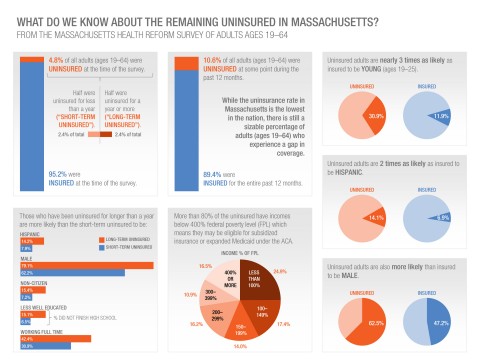
This report is the latest in a series by the Urban Institute analyzing the impact of the Massachusetts health reform law based on the Massachusetts Health Reform Survey (MHRS).  Findings show that that the remaining uninsured are disproportionately young, male, Hispanic, and non-citizens.  The data presented also show the geographic areas of the state with high numbers of uninsured children and non-elderly adults. Suggested outreach strategies to reach the remaining uninsured include targeting specific populations of uninsured individuals as well as specific geographic areas with higher rates and numbers of uninsured. Click here to view a one-page graphic with key findings from the report.

Uninsured_in_MA_infographic_jpeg_0

Closing the Gap on Health Care Disparities

From 2008 through 2011, the Foundation supported 11 community-based coalitions across Massachusetts through its Closing the Gap on Health Care Disparities Initiative. This report, prepared by Mary Coonan and Terry Saunders Lane of The Center for Social Policy, University of Massachusetts Boston, explores areas of coalition development, system change, and public awareness. It articulates strategies that worked well, challenges that emerged, and factors that explain variation to inform foundations, community organizations, and health care institutions working to address disparities in health care and outcomes. 

Chapter 224: What Does It Mean for Hospitals, Health Plans, Consumers, and Clinicians?

These fact sheets highlight the major implications of Massachusetts’s 2012 health care cost containment law, Chapter 224, for four key stakeholder groups:  hospitals, health plans, consumers, and clinicians. From increased data reporting requirements for hospitals and health plans, to greater cost transparency for consumers, Chapter 224 will have significant impacts on many aspects of the Massachusetts health care system in the years ahead.

For a comprehensive overview of the entire law, see the Foundation’s report: Summary of Chapter 224 of the Acts of 2012. For an in-depth look at the Medicaid provisions in the law, see the Foundation’s report: Chapter 224 of the Acts of 2012: Implications for MassHealth.

Chapter 224 of the Acts of 2012: Implications for MassHealth

This report, written by Robert Seifert and Rachel Gershon of the Center for Health Law and Economics at UMass Medical School, examines the key components of the most recent Massachusetts health reform law - Chapter 224 of the Acts of 2012 - as they pertain to the Massachusetts Medicaid program (“MassHealth”). Under the new law, MassHealth will be subject to the annual spending growth benchmark and will be required to implement alternative payment arrangements for most of its members, among other new requirements and responsibilities.  For a broader overview of Chapter 224 of the Acts of 2012, see the Foundation’s report: Summary of Chapter 224 of the Acts of 2012. For additional information about scheduled stakeholder meetings, grant opportunities, and other implementation updates, see the state's website, Implementing Health Care Cost Containment.

Summary of Chapter 224 of the Acts of 2012

This report – written by Anna Gosline and Elisabeth Rodman of the Blue Cross Blue Shield of Massachusetts Foundation – summarizes the key components of Chapter 224 of the Acts of 2012, “An Act Improving the Quality of Health Care and Reducing Costs Through Increased Transparency, Efficiency and Innovation,” which was signed into law on August 6, 2012. The law aims to control health care cost growth through a number of mechanisms, including the creation of new commissions and agencies to monitor and enforce the health care cost growth benchmark, wide adoption of alternative payment methodologies, increased price transparency, investments in wellness and prevention, an expanded primary care workforce, a focus on health resource planning, and further support for health information technology, among others. For a more in depth look at the Medicaid provisions in the law, see the Foundation’s report: Chapter 224 of the Acts of 2012: Implications for MassHealth. For additional information about scheduled stakeholder meetings, grant opportunities, and other implementation updates, see the state's website, Implementing Health Care Cost Containment.

Sick in Massachusetts: Views on Health Care Costs and Quality

This poll – conducted in April and May 2012 by researchers at the Harvard School of Public Health – asked “sick” Massachusetts residents a series of questions related their perception of health care costs and quality in Massachusetts, the reasons for cost and quality problems, and their personal experience with cost and quality issues. The results showed that sick residents are very concerned about health care costs in Massachusetts, and some struggle with their own costs of care. Though respondents were less troubled by the quality of care in the state, there were indications of problems, especially around care coordination and communication. The poll was conducted in partnership with 90.9 WBUR and the Robert Wood Johnson Foundation.

Benefits of Slower Health Care Cost Growth for Massachusetts Employees and Employers

This report by Jonathan Gruber of the Massachusetts Institute of Technology models the potential benefits to the economy if health care costs were to grow more slowly than projected. In the face of rising health insurance costs, studies find, employers tend to reduce or blunt the rise of employee wages as well as offer less generous insurance coverage. But employers cannot pass along all the increased costs of health insurance as decreased wages and benefits. Any additional costs must be offset either by cutting jobs or by accepting lower business profits. This report presents three potential scenarios of slower health care cost growth between 2011 and 2019 and models the subsequent impacts on employee wages, employer spending on health insurance as well as employer profits and workforce investments. The report finds that slower growth in premiums would result in billions of dollars in savings for both employees and employers. 

The Interactive Guide to Chapter 288

An online, interactive guide to Chapter 288 of the Acts of 2010, Massachusetts' most recent health care cost containment law. This online tool includes full, up-to-date text, section-by-section summaries and links to relevant reports, commissions, state agencies and final regulations.

Start Here

Health Reform in Massachusetts: An Update as of Fall 2010

This report is the latest in a series by the Urban Institute analyzing the impact of the Massachusetts health reform law. Findings show that despite the state's economic recession Massachusetts has maintained record low levels of uninsured and access to needed health care has improved. This report is based on the 2010 Massachusetts Health Reform Survey (MHRS), which has tracked the impact of the law annually since 2006.

Massachusetts Health Reform: A Five-Year Progress Report

Blue Cross Blue Shield of Massachusetts Foundation report by Alan G. Raymond on the first five years of Massachusetts health reform implementation, including comprehensive assessments of how the law is working, impacts on coverage and access to care, and cost and funding.